Wednesday, September 9, 2020

Self-Reflection Following Interview

 I feel like I did very well throughout the interview. I believe I was able to display and show my personality and my love for the setting I was interviewing for. I also felt confident going in and felt comfortable talking and discussing with her about why I would make a good candidate for the position.

Honestly, I did not do much to prepare for the interview. I am a people person, and I am very comfortable talking and discussing with others. I looked over some questions to ask in the interview, but that is honestly all I did to prepare. I think my personality and my ease at talking is an asset when it comes to interviews, so I always feel comfortable and confident with them.

I wasn't expecting to be asked about a situation where I had to handle a disagreement. I just never thought of that being something to think about in an interview for a job. I think I handled it well, though, and I was ready and prepared with a way I would approach the situation.

If I could change anything, I so not believe I would change anything. I felt really good about how it went and I had reciprocating feedback from my interviewer. I am happy with how the process went.

I think I am more prepared for questions about my future and my goals after this interview. I am pretty set on the field I want to be in and the milestones I want to accomplish as an occupational therapist. I think this interview just solidified that for me.

Wednesday, July 29, 2020

Glyph Jan. 2019--> July 2020

My glyph has changed throughout my time in OT school. My glyph, now, has a triangle and square head. I believe that it is both an inborn trait and something that can and does stem from nurturing. My hair is also straight and wavy, meaning I believe creativity and organization are both elements that need to be seen in leadership. My hair is also medium length as opposed to short; I think there are introverts that can be effective leaders, but I do believe that usually extroverts are seen in leadership roles more often because it is something that comes more easily and naturally to them. I also did not put a hat on my glyph this time. I don't feel like my idea of leadership has changed in regard to my education and time in occupational therapy school. If my leadership style has changed any, it I because I have learned in this past year and a half more about myself- I spent time learning and growing and focusing on my mental health. However, I feel like my leadership style is still the same as it has always been.

            I think what has really changed through my time in OT school is that now I am more comfortable pushing the boundaries and better at being in the gray area. I am a very by-the-book person. I follow the rules, and things are yes or no. I think that is what played a major role in my first glyph; I felt the need to choose between the two options. Now, I am more comfortable in the in-between and doing a little bit of both.

[I do not know why my new drawing looks so evil- I am sorry!]

Locus of Control

When I did the Rotter Locus of Control test, I got a 10 out of 23. So, relatively on the lower end and more of an internal locus of control. Internal locus of control is when you believe that you yourself have control over the outcomes and events in life, rather than an external locus of control which means that people believe external forces and things other than their control are what control the outcomes of life. Locus of control is one dimension of core self-evaluations; along with locus of control, there are also other dimensions such as neuroticism, self-efficacy, and self-esteem. I did not know this, and it is interesting to me because it does give a very solid look at how a person views themselves and how they approach adversities and complications they may face throughout life. An internal locus of control will drive someone to believe that they must take responsibility for their actions and whatever happens following them, whereas someone with an external locus of control would blame things such as luck, the work of other people, or other circumstances going on around them.
I think my score of 10/23 was a very good representation of myself. I believe that you are responsible for the way your life turns out. You have a brain and you have morals, and it is up to you to make the decisions and choices that affect your life. I do understand, that there are external forces that can affect you. I believe a sickness in the family can affect how your life unfolds; I have seen this happen to my best friend and I know it happens to a lot of people. I believe that there is bad luck, and sometimes you just have to roll with the punches and things change from how you may have planned for things to go. I was always taught growing up that life isn’t fair and that if you want something you are responsible for getting it. I think growing up with that mantra from my Daddy has helped me get to where I am and has led to my more internal locus of control. While things from the outside can affect me, it is ultimately up to me to make of it what I can and get to where I want to be.

Wednesday, November 13, 2019

Peds SIM Reflection

I feel like, overall, my encounter went okay. There were definitely some areas where I could have improved. I feel like I went through all of my information quick and maybe didn't give myself enough time to really see if she understood what I was saying. She seemed very nervous and I don't feel like I addressed her feelings maybe as much as I should have.

If I could go back and do something differently, I would try to be more understanding when she seemed like she was about to cry. I also would have maybe brought up her constantly checking her phone, now that I have had time to reflective about how I would address it.

Two ways you can show a caring attitude towards your client is by being aware of your positioning and allowing them time to express their feelings and validating their feelings so they know they have been heard. Positioning is very important; making sure you are making eye contact and your body language shows that you are engages and interested. No slumping or body being turned away from the client because these automatically make the client feel as if you are not listening to them. Validating their feelings and actually listening to them is also very important. giving them time to express their concerns and frustrations and maybe let them vent to you is important for building a therapeutic relationship. It is also important to let them know that it is okay for them to be experiencing the feelings they are feeling, and that they should not be ashamed. Doing these things shows them that you care about them and their feelings and that they are not just another "patient."

I think I will take from this lab more about how emotional it can be working with a family. I feel like now that I have been exposed to it, I feel more confident in that situation for when I experience that in  practice. I know it is something I need to work on, but I feel better now that I have had a dry run with it and can see where I need to focus on improvement.

Tuesday, August 27, 2019

Neuro Note #4

My Conscious Decision

MamaJama · May 31, 2018. (n.d.). My Conscious Decision. Retrieved from    https://multiplesclerosis.net/stories/my-conscious-decision/

This blog post was written by a woman who is experiencing life dealing with multiple sclerosis. She talks about how during this 11 years of her diagnosis, she can tell you all of the things she has lost and what the disease has taken from her. However, she is so positive about it. She mentions how she doesn't want to dwell on what her life could have been or what she could have been doing because she knows nothing in life happens on accident. She takes her set backs and uses them as stepping stones. She mentions how she has learned what is important is to be genuine, smile at people and tell them that you love them because everyone deserves to be and feel loved. She wrote this post the night before her 45th birthday. She says that on this journey, she isn't taking anything that weighs her down. She wants memories and laughter and chocolate. 

I chose this because, like the other posts I have written about, she is positive and her outlook on life while dealing with a disease that is crippling is so positive. She focuses on the good; she is happy and while she can't do everything she used to do, she isn't useless. She isn't carrying the burden of "what if" around. It is really just so important to me to see people with a positive attitude. I like to think I am a positive person, and I would really hope that I would have the same sunshine-y attitude.

I think what I learned from this post greatly reflected what we had learned in lecture about multiple sclerosis. She doesn't mention which type of MS she has, but from the way she talks she never recovers to baseline. She has lost sensation on one side, she has problems with vision on one side and can no longer walk unassisted without a walker. one thing that really struck me was how she can't handle the heat anymore. I think that is interesting and I would want to know if she can't handle the heat from the disease and its affects or from the medications she has to help with symptoms from the MS. I would recommend this article to anyone, honestly. It is just a moving and uplifting post that just goes to show that even in the bad times, you can still be optimistic. 

Monday, August 26, 2019

Media Project Reflection

I think the most meaningful thing I learned through this assignment was just the endless amount of ways you could take something as meaningless as an empty soda bottle and turn it into something beneficial for someone. I also think it is amazing to see just how many ways you can fit an item to a person in relations to their diagnosis, their needs, and who they are as a person.

I didn't realize before this assignment just how complex a diagnosis can be and just how specific an occupational therapist really has to focus on when planning interventions. Barbara, my client, not only had less strength in her upper and lower body, but also fatigued easily. When it came to designing an intervention, that was something I had to consider was that she fatigued easily and couldn't be up standing and moving around for a long period of time. It is like a puzzle and you are trying to make that last piece fit in; you have to figure out the "just right challenge."

Completing this assignment made me really feel like I was in the mindset of an occupational therapist. I really felt my OT think kick in when I was thinking of the different ways to use a plastic soda bottle. Making it into a craft, which was something that she enjoyed doing, and turning the empty bottle into a flowerpot that could be enjoyed by not just herself but also her family was a way to address her goals and do something that kept her interest. I think this assignment helped me shift my headspace into thinking of an OT more so than just a student.

Monday, August 19, 2019

Neuro Note #3

From high school to nursing home: 20-year-old learns to cope with fatal disease

Sioux City Journal
siouxcityjournal.com

This was a post made online in the Sioux City Journal about a young girl, Desiree Buettner, who began showing the symptoms of Huntington's disease at 18 years old. Her mom passed away form Huntington's when she was only 26 years old. Even though Desiree knew that there was a good chance she would get the disease, it still left her feeling depressed when having to cope with the symptoms at such a young age. She had to move into a skilled nursing facility because she needs so much assistance with tasks such as grooming and she even has difficulty talking. The staff has done a lot to make her feel comfortable inside the home, because she is by far the youngest resident. They made a bucket list with her and have been doing things on it like going to Disney World. Her room is decorated with posters and she has video games to play that not only entertain her, but it also keeps her hands and fingers moving and working those fine motor muscles. It mentions how she couldn't play sports because she was so clumsy (from the Huntington's) and she never got the opportunity to graduate high school. That is a big lifestyle change for a 20 year old girl, especially a young girl who knows her fate, but she is taking it in stride and dealing with it in the best way possible.

I chose this post because this girl is not that much younger than me. I know how much I have gotten to experience since high school and the opportunities I have had to be out on my own and learn and try new things. For her, this isn't an option. She can't be "out on her own." I just relate to it because I couldn't imagine, at my age, to have to live in a skilled nursing facility. I have spent a lot of time in SNFs, and they are not an environment for a young girl. 

What I learned most through reading this is how these types of diseases do not care. They present in someone when they want and how they want. This girl, who knew what her odds of developing this disease were, didn't even get to finish out high school before it took over to the point of where she needed assistance with almost everything. I also think it is interesting that her mom had juvenile Huntington's as well. While we know the this disease is a family disease, I was surprised to see that Desiree also presented with juvenile Huntington's since the disease usually doesn't present until the 30s. I also learned how important it is to have such a big support system; whether that be family, caregivers, or friends it is important to have people around you that care and want to help you experience all that life can offer when what is inevitable is known. The staff at her skilled nursing facility took her to Disney World because she didn't have the chance to go before. they rode rides and stood in lines for hours so she could get pictures with all of the Disney princesses because that is what SHE wanted to do. I think it is special to see that there are people willing to go to that extremes to help people and put a smile on someone's face.

Tuesday, August 13, 2019

Neuro Note #2

Ray's Little Ride
One Year

Rayslittleride. (2016, May 24). One Year. Retrieved from https://rayslittleride.com/2015/12/16/one-  year/


t    This blog post was written by a man who is telling his story of how his life is 1 year after the diagnosis of ALS. He talks about how he went from delivering babies and being on call at work to having to switch to strictly clinical work and then quitting altogether due to symptoms from his diagnosis. He went from being an outdoorsman hiking and adventuring to needing help getting dressed. he discusses how he is much slower now. He mentioned how he used to always have to wait on his wife to get ready whenever they went out, but now even if he starts getting ready before her she is still ready before him. His world flipped upside in less than a year. He discussed how hard it was for him to tell people. He didn't even know what to say and he has trouble saying "I have ALS." Everyone reacts different to being told about the diagnosis; some of his family blatantly ignored it and said they weren't going to deal with it until they had to while others didn't really understand what ALS was and had to research it before calling back being completely off-beaten by it. He talked about how they were having to modify and make adaptions not just to his clothing, but also their house. They lived in an old house that didn't have a bathroom downstairs. Installing a lift chair was too expensive, so they were having to see how they could make other adaptations for him to be able to be bathed ad showered since the stairs were beginning to be out of the question for him. 

     It amazes me his positivity and strength he shows throughout his blog post about facing this disease. The mental aspect is such an important part in any progressive disease like this, that has no cure. He ends his post by saying that despite everything, he is still standing. He might be a little bruised and beaten now, but he is still standing. His outlook on his life is remarkable; he sees it as a new adventure everyday that they have to face. I think an attitude like that is what keeps people like him fighting and carrying on, despite the fate they have been dealt.

     I chose this because I think it is so important to see positivity and light in something others see as dim and hopeless. His outlook of facing every day head on as a new challenge to face and overcome is so special. it is an attitude I would hope I would have if I were ever to be in a circumstance such as him. we are all dealt cards in life and we have to play that hand. I just hope that I can play my hand as optimistically as Ray.

      In this post you could see the deficits the disease was starting to leave Ray with. He no longer could dress himself and needed adaptive clothing to make dressing as easy as possible. You could see his physical health decline throughout his story of a year of his diagnosis. Also, you could see how quickly the disease progressed with him. His diagnosis was in the end of December and he already had to leave his job by the next August. Also, you could see the family dynamic that is in Ray's life. His family was there around him to help and comfort him and you can see how that has helped him throughout this process. Hearing something from a first hand experience always makes it more personal and you get a deeper understanding of how the disease plays a role in the daily life of someone. It isn't just words on paper anymore, it is someone who is a father, husband and friend.

Monday, July 22, 2019

Neuro Note #1

How I'm Preparing to Get Alzheimer's.

Ted Talk Video

Shaikh, A. (2012, June). How I'm preparing to get Alzheimer's. Retrieved from https://www.ted.com/talks/alanna_shaikh_how_i_m_preparing_to_get_alzheimer_s?referrer=playlist-the_fight_against_alzheimer_s#t-355912


I watched a Ted Talk video given by Alanna Shaikh on how she is preparing to get Alzheimer's disease. Because she is currently living with her father fighting this disease, she has personal insight along with knowledge of it and the effects it has on the people who are diagnosed with it and the people who care for them.

I chose this Ted Talk because my great-grandmother has Alzheimer's disease and I have seen wha tit has done to her over the years. It is scary how much this disease can really take from you and this video grabbed my attention because Alzheimer's does run in families. I loved the idea of a powerful and positive approach to the fact that Alzheimer's is a big possibility for her, as it is me.

In this video, Alanna goes on to talk about the statistics of how prevalent Alzheimer's is and what the number is expected to be by 2030 (70 million). She talks about how she has watched her dad essentially disappear over a decade. While most people automatically associate Alzheimer's disease with the cognitive deficits that develop, there are also physical deficits that also create more difficulty for these people. Physically they lose balance and because of falls, they begin to live a more sedentary lifestyle out of fear. The people who most often had pretty active lifestyles before begin to fear being active because they are scared to fall. This, along with the well known cognitive issues, leave people basically in a shell of a man. Alanna knows that she is at a greater risk because of the family history, but instead of being in denial or trying to do everything under the sun to prevent the disease from coming, she made a list of things to help her prepare for when and if she is diagnosed. She is already doing the things the doctors all recommend, being physical active everyday and eating healthy. However, she extended upon that to make sure that she was as prepared as she could be. She is changing her hobbies, improving her physical strength, and working on being a better person.

Hobbies. It can be anything from reading, relaxing with tv, or being out working in a garden or cooking. When Alzheimer's begins, a lot of those abilities are lost. So, she is working on hobbies that she would still be able to do if she were to be diagnosed. Because the more things her hands are used to doing now, it will be easier for her to do them and enjoy them when her brain is no longer working normally. She has started incorporating exercise that improves her balance like tai chi and yoga. That way, when she starts to lose her balance she will still be able to be mobile. Lastly, she is working on being a better person. She said her father was always kind and loving, and she was never as loving as him. Because her dad has always been so kind and pure, it makes it easier to be around him now when it seems that he isn't the same Dad. She wants a heart so loving a pure, that once it is stripped by dementia and Alzheimer's her heart will shine through like her father's.

She mentions that the monster is going to get you if it wants you. It doesn't matter how great of a person or how smart you are. If Alzheimer's wants to get you, then it will. Her father was bilingual and a college professor, and it still got him. She wants to be prepared to face the monster head on if it comes to that. She wants to be prepared.

The way Alanna Shaikh looks at life is so important. We have learned so often that a person's outlook and determination is a big part of dealing with a neurological disorder like this. She is already getting ready; she is facing it with a smile on her face and a card in her back pocket because she doesn't want it to destroy her like her father. I think that is a great way to look at it. There is no denial that it won't effect her. She knows the possibility. She knows that statistics. She is ready.

Sunday, June 9, 2019

Restoring Confidence

The reason for the hierarchy is to ensure the clients are safe and have the ability to regain their confidence in being mobile. The first, or the bottom of the hierarchy, is bed mobility. It is the most important because if you cannot move in the bed because if you cannot move in the bed, it is going to be very difficult to transfer from a bed to be able to toilet and and get into a wheelchair. Once bed mobility has been sufficiently mastered, you can begin to start working on transfers to a mat. Following mat transfers are wheelchair transfers, bed transfers, functional movement or ambulation for ADLs, toilet and tub transfers, car transfers, functional community mobility and then mobility in the community and driving.

The hierarchy makes sense the way it flows, but honestly I did not originally think about it being this in depth. The reasoning for the hierarchy is so the client can build upon already mastered skills. This makes the client feel comfortable and confident when transitioning to a new skill. Starting a client off automatically trying to be able to move around within their community is not an easy task; therefor, you begin at the bottom and work your way up to a skill that requires several things going on at once. I did see this when I was observing occupational therapists before I began school. I worked a lot in a nursing home, and for some clients we went to their rooms because at that time they were not able to transfer to a wheelchair. So, we worked on them being able to move around in the bed and cultivated activities they could do in bed until they have mastered that and were able to get into a wheelchair and go to the gym.

I definitely agree with this approach to transfers. It is like the old saying, "you have to learn to walk before you can run." It is important that clients are confident in themselves after a health incident where they have been set back some. For me personally, I broke my femur and it took me a little bit to be comfortable and confident in my body's ability after that. So this hierarchy of starting with the less difficult tasks and building upon those makes sense to me. The labs and SIMS labs really drove home the feeling and honestly made it more applicable to what we will be dealing with once we start to practice.


Sunday, June 2, 2019

Assistive Devices

Assistive devices beneficial and extremely important in our field. It is important to make sure these devices, such as walkers, canes and crutches properly fit our clients. It is important to have them properly fit because:

1. When the devices are properly fit to the individual client, it promotes better body mechanics and better mobility while using the device.

2. It prevents further injuries, stress or trauma to the client's body.

A client that is using a device that is not properly fitted to them could possibly lead to a fall which would lead to more problems and issues for the client.


Fitting a client for assistive devices is easy and does not take much time. In order to fit a client for a cane or walker, the OT is going to identify some specific landmarks on the client's body. The handgrips should be at the ulnar styloid, wrist crease or greater trochanter. It is also important to note that the clients elbows and shoulders should be relaxed. For a platform walker, the client is positioned where the elbow is bent 90 degrees while standing upright. To avoid any nerve compression, the proximal ulna should be between 1-2 inches off the platform. The handle of the platform should also be fixed slightly medial to allow for grip.

For crutches, the landmarks that should be used to fit the device are the same for the cane and walker. However, for axillary crutches, the arm rest should be about 5cm below the axilla with the client's shoulders relaxed. For forearm crutches, the arm band should be positioned approximately 2/3 of the way up the forearm with the handgrips facing forward.

Wednesday, May 22, 2019

Body Mechanics

Good posture and body mechanics are important for several reasons. It is important to teach good posture to prevent back problems through development and into adulthood. With back pain being one of the most common issues today, teaching good posture can allow people to live healthier and happier without as much pain. Ask anyone with back pain how aggravating it is;  by teaching good posture we can improve the quality of life for many individuals. Body mechanics are important to teach to prevent injuries such as strained muscles and disc problems. Teaching people to lift with their legs and not hunch over can prevent many injuries that happen all too often. Teaching proper body mechanics also makes it easier for an individual to get a task done. If we are teaching our clients how to use proper body mechanics to move a large crate, they can get it done easier and without as much as stress on their body rather than them struggle to move it and potentially lead to more issues. Body mechanics make movements more efficient. Lastly, body mechanics are important to teach for the safety of other individuals. For example, if a nurse is having to do a transfer alone, without proper body mechanics and knowledge, he or she may harm or risk harm to their patient. It is safer for everyone, all around, to use proper body mechanics.

An example of how to teach proper body mechanics in an intervention would be to use a stick/pole and place it behind the client where it is in line with their head and back. Then instructing the client to squat and maintain the pole on their back to prevent them from hunching over. This makes the client have to squat with their legs to reach down and pick up something, such as box. An example of teaching proper posture during an intervention would be instructing the client to sit and then showing them where their posture is lacking. In this scenario we will say that they stick their head and neck out forward instead of having it in alignment with the body. Hold a small pillow or towel on the wall behind them and instruct them to slide their head back and hold the towel on the wall. This will make them correct their posture. Also, instruct the client to think about this while driving and to push their head back into the headrest. This will help maintain good posture while driving.

Saturday, May 4, 2019

Man from the South

In this short story, the better's wife only had 2 fingers left on her hand. She only had her thumb and index finger. While it did not specifically say in the story that the hand with the amputated fingers was her dominant hand, we can assume it was because she instinctively reached out with that hand. An occupation that she would have trouble with due to this would be being able to shave her legs. Because razor handles are smaller and have a thinner handle, with only a thumb and an index finger, she would have difficulty grasping and maneuvering the razor.

A modification that could be used would be having a razor with a built up handle. A thicker handle would make it easier for the wife to use and hold onto. Another option as a modification would be to use an electric razor. Because electric razors have batteries that need to be charged, most all of them are larger anyways. The wife could easily handle this type of razor in order to shave her legs.

Friday, April 19, 2019

Health Promotion and Literacy

I had never heard of the Triple Aim before our lecture yesterday. The Institute for Healthcare Improvement has this initiative to support and promote a better healthcare system. It includes improving the patient experience and quality of care, improving the health of populations and reducing the per capita cost of health care. These are the main focuses of the initiative and I think it is a good way to shed light on an area that desperately needs improvement.

Watching the video yesterday where patients discussed with their medical professionals that they couldn't read and didn't know how to take the medicine and didn't know what they were taking really hit home with me, and in more than one way. I was a member of Pi Beta Phi throughout undergrad and our focus was literacy and promoting it in areas that were filling behind in it. I got to see first hand in our community where children and adults could not read at a high level. Also, I am from a rural town. A lot of the people in my town are just like the patients who were interviewed throughout that video; many of them read on an elementary level and do not understand the medical terms they are told day in and day out. The lady who said she didn't realize that she was signing papers to get a histerectomy broke my heart. I really do not understand how medical professionals didn't speak with her and talk to her about this before the surgery. It is just an eye opening video that shows how we as medical professionals have to be very adamant about making our clients feel comfortable with us that they can let us know when they do not understand anything or are confused. We have to prevent things like that from happening.

Sunday, April 14, 2019

Biomechanics #3


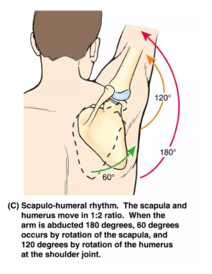
Image result for scapulohumeral rhythm
Scapulohumeral rhythm is important in regards to clinical practice because it is the ratio of movements between the scapula and the humerus. It gives the practitioner knowledge of if the humerus is moving so many degrees, then you can deduce how much the scapula is moving. Generally, for every 3 degrees of shoulder movement, then there is 1 degree at the ST joint and 2 degrees at the GH joint. It is the movement of the shoulder complex, which includes all structures and muscles, all together at once. This is important because if there is damage or trauma to one part, or one muscle, it will directly effect the ability of the other muscles to work properly. It can effect the range of motion in the shoulder because there won't be a full range of motion in the shoulder in specific movements when certain muscles have been effected. In order to obtain full range of motion in the shoulder, which is roughly 180 degrees, the humeral head must rotate laterally. When it rotates and reaches full ROM, the ST joint has moved 60 degrees and the GH joint has moved 120 degrees. This demonstrates the ratios of movements and scapulohumeral rhythm.

Monday, April 8, 2019

Universal Design

    TED talk was really interesting to me. He started off joking because of the female interpreter and really set a light tone to discuss something that is really serious and something that impacts everyone every day, especially as OT practitioners. I really liked how he said that everyone has a disability at some point in their life; whether it be temporary or long term, everyone experiences this at some point. Universal design is a concept that is important for everyone to be included and everyone be able to easily access and experience things. He talked about the automatic door being a universal design. To be completely honest, I had never thought about an automatic door being implemented as something to make it more accessible for everyone. I know I should have recognized this, but I have grown up seeing them everywhere and it never occurred to me that this was designed to be more inclusive.
    I listened to the podcast about home health with occupational therapy. It was interesting to me because she was talking about how she was bored in her SNF setting and home health allowed her to use more of her own creativity. She mentioned how she loved being able to actually see the set up of where they are and where they needed help, like with showering. I actually did observation hours in a home health setting, and I was able to go to different client's homes and watch the OT work within the home. I was not a big fan of this setting myself, but it was interesting to listen to her talk about how you could put a bar of soap in a pantyhose leg and tie it to a safety bar so if they drop the soap, they don't have to bend down all the way to get it. It was interesting to see another person's view on this setting and have a positive outlook on it compared to my outlook which was not a very positive one.

Sunday, April 7, 2019

Biomechanics Blog #2

It is important in to use appropriate bony landmarks and proper positioning for ROM in order to get the most accurate reading for range of motion. It ensures joint stability and is more reliable and valid to measure using the bony landmarks. It is important to use the correct placement for accurate measurements so your documentation can be read and used for other practitioners that may see the client after you or while you are treating them. Using appropriate landmarks also makes it "universal" when taking measurements. This way across the board, the same ROM can be taken no matter who is administering it.

The purpose of the test position in MMT is that we went to measure in mid-range of movement because that is where the most cross bridges are being formed and you get the most accurate reading of strength. This mid range position is the position for optimal muscle contraction, and that is what we want to measure. The gravity eliminated position is important for clients who cannot even resist gravity, so in order to get a reading for MMT, they need to be in a position where gravity is not a resistance for them. This means placing them where the joint is parallel to the ground, therefor eliminating gravity from the muscle contraction.


Thursday, April 4, 2019

Biomechanics Blog #1

An action that is part of my daily life is squatting to sit in a chair. When you start, you are standing upright. The end position is a supported squat sitting in a chair. The hips plane of motion is saggital and the axis of rotation is frontal.  The knees follow suit and the plane of motion is saggital and the axis of rotation is frontal. In osteokinematic terms, the knees are producing flexion when squatting. Arthrokinematic movement at the knee joint is the roll and slide. The prime movers for this action of sitting in a chair are the gluteal muscles. They move eccentrically when squatting down and when returning to the standing position they are concentric.

Thursday, March 28, 2019

Therapeutic Relationships

Therapeutic relationships was an easy topic for me to grasp. I worked in a rehab clinic prior to school, and I was bale to develop this type of relationship with the people I worked with there as a rehab technician. I think for me, it is easy to talk to anyone about anything and build rapport with them. Some of the therapists I worked with will occasionally get in touch with me saying a patient has asked about me and how I was doing in school. It is a good feeling to know that you made an impression on someone while you were helping treat them.  So my biggest take away from the last lecture was that the therapeutic relationship is the foundation; you need this to be able to treat a client effectively and help them reach the goals they have set for themselves.

Thursday, March 14, 2019

History of Disability

   I believe the main take away from today's lecture was to see how far our nation has come in regards to treatment of individuals with disabilities. I think it is important for us to be able to see where we started and how far we have come, but also to be able to see where we are still lacking and where we can continue to improve.
   I kept thinking back to Era Presentations throughout the lecture today because a lot of the material he spoke on had been briefly mentioned during those. The legislation that was discussed was all spoken and covered during Era Presentations, so I felt better knowing I already had an understanding of legislature regarding disability and the movement towards a more inclusive society.
   I think all of this that has been covered will effect us as OT practitioners because we know how people who had a disability were treated before, and our profession advocates for inclusion and promotion of people, whether they have a disability or not, should be able to live as a typical individual would.

Self-Reflection Following Interview

 I feel like I did very well throughout the interview. I believe I was able to display and show my personality and my love for the setting I...